Why you can’t relax when there’s nothing to relax about
Life is fine. The week is ordinary, nothing is wrong, and you are still braced for something. Then somebody tells you to relax — and the advice is so obviously correct that failing at it starts to feel like a verdict.
The advice assumes the problem is effort
“Just relax” isn’t really an instruction. It’s a description of the desired outcome, handed over as though naming it were the hard part. If relaxing were available you would have done it, which is the whole of why the sentence lands badly — and why the people saying it are usually surprised by the reaction.
The mismatch is between what the phrase assumes and what is actually in short supply. It assumes calm is a choice you keep declining to make. What people describe instead is a body that stays on alert long after the moment has passed: constantly on edge, braced for something, struggling to relax even when life is objectively calm. That last clause is the one that matters. The difficulty isn’t proportionate to what’s happening, which is exactly why arguing about what’s happening doesn’t move it.
Why calm isn’t a decision
Your nervous system has a range it works well inside. Above it you are reactive; below it you are flat. Most of what gets called a focus problem, a temper problem or a motivation problem is a system operating outside that range — and so is a good deal of what gets called not being able to relax. Arousal regulation is a measurable property of the nervous system, and it varies, across people and within the same person across a day.
It also isn’t fixed. Regulation is a capacity that depletes and recovers, which is why an ordinary Tuesday evening is manageable one week and not the next. Nothing about the week got harder; what was available to meet it got smaller. Consistency is the wrong benchmark, and holding yourself to your own best day sets a standard the system cannot meet.
Being told to relax is being asked to spend the thing that has already run out.
It is also why the standard advice underperforms. Most strategies for regulation require the very capacity that is in short supply — they work when you don’t need them and fail when you do. “Notice it before it escalates” requires the noticing. None of that makes the strategies wrong. It makes the conclusion wrong, and the conclusion is usually that you didn’t try hard enough.
What tends to help
Put the structure outside yourself. Something that runs without your attention beats something that needs it — the same sequence every evening, an alarm rather than an intention, a decision made in the morning about what the evening is allowed to contain.
Lower the demand before it fails rather than after. A thing postponed by fifteen minutes often goes fine; the same thing pushed through a rising state usually costs the next hour, and the argument afterwards is rarely about the thing.
Treat the load as the intervention rather than the background. Sleep, food and unbroken recovery time are not the soft version of this — they are the largest single lever most people have and the first thing dropped when the week fills up. A few weeks of honest attention there tells you what is left underneath.
And rule out the ordinary causes, because several of them produce exactly this. Thyroid problems, low iron, sleep apnea, medication effects, and mood and anxiety disorders are common, and they are identified by testing rather than by inference. If nobody has looked, that is the thing to do first. We can’t do it, and neither can an article.
If nights are the hard part
Evenings are when most people notice this, and not being able to switch off at bedtime is one of the most common things anyone tells us. Sleep is its own subject though, with its own page and its own answer: a mind that won’t settle at bedtime and a body braced at two in the afternoon are not one problem wearing different clothes. If the nights are the main event for you, start there instead — the link is at the foot of this page.
Where LENS fits
An anxious nervous system often feels like a system working harder than it needs to, and a LENS session asks nothing of it — small sensors, a very low-energy feedback signal, nothing to perform and nothing to practise between visits. Most people, including young children, feel nothing at all.
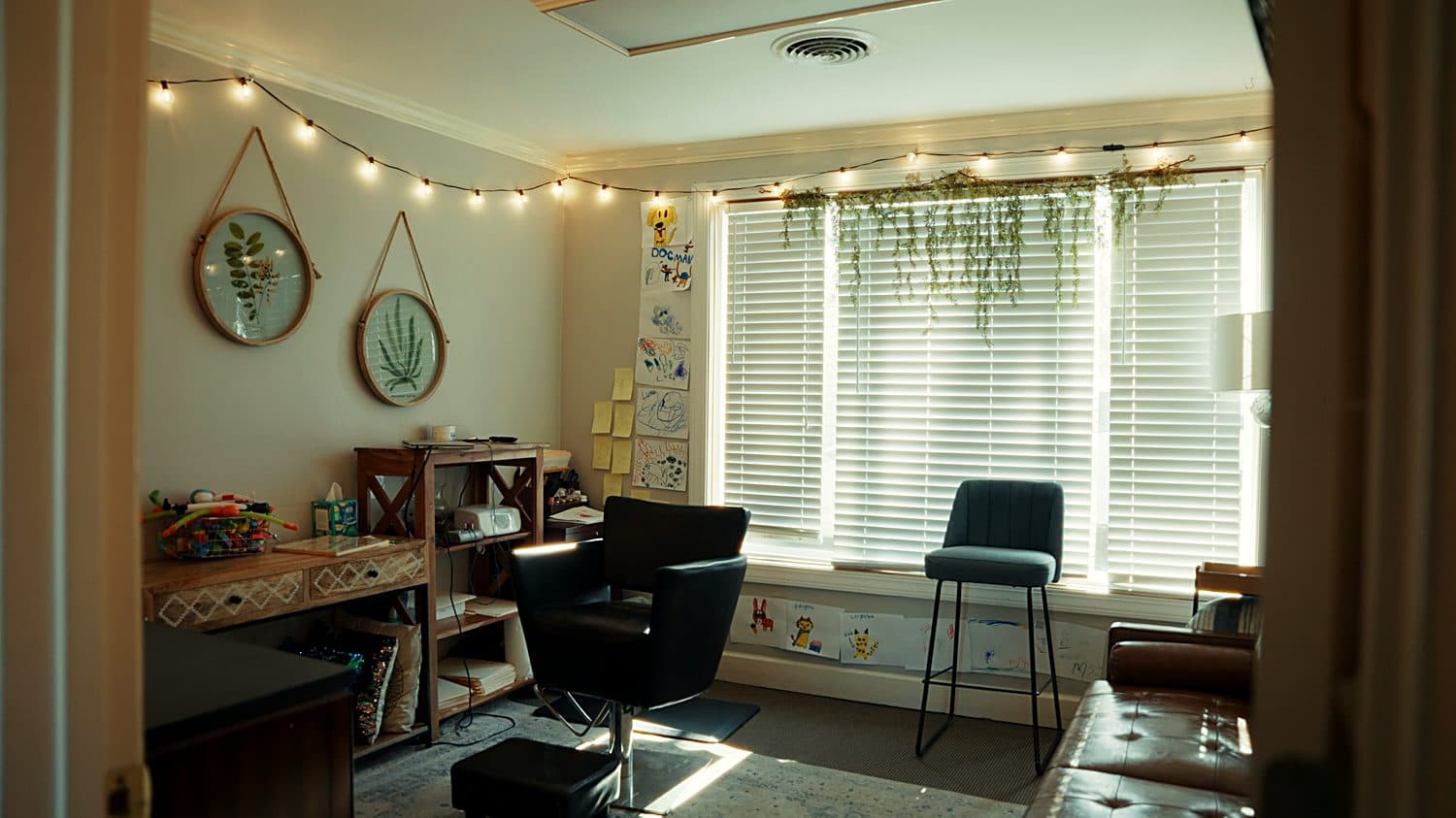
Sessions run about 30 minutes in a comfortable chair, and many clients read or simply rest. It is one of the calmest hours of most clients’ week, which is worth stating plainly to somebody who has spent years being told to relax: there is nothing here to get right. Clients commonly report feeling steadier over a series of visits, and how much changes varies from person to person, which is why we ask at every visit rather than predicting.
Where this goes next.
LENS is a wellness service. It works alongside — never in place of — your doctor, therapist, or school supports.
Tell us what it actually feels like. We’ll be straight with you.
Bring the version you don’t say out loud. We’ll listen, answer honestly, and say plainly if LENS isn’t the right fit — before you book anything.
If we don’t think LENS is right for you, we’ll tell you on the phone — before you ever book or pay for anything.
The call is free · No referral needed · HSA & FSA accepted