Why your body stays braced when nothing is happening
The meeting ended two hours ago. The jaw is still set, the shoulders are still somewhere up near the ears, and the stomach has its own opinion about all of it. Nothing is happening. The body has not been told.
Bracing is a state, not a mood
People describe this to us in physical terms far more often than emotional ones — carrying stress in the jaw, the shoulders, the gut; unable to recover after a difficult day; functioning perfectly well and quietly running on empty. The word “anxiety” sometimes never comes up, because it doesn’t present as a feeling. It presents as a body doing something nobody asked it to.
That is a reasonable way to describe it rather than a euphemism for one. Arousal regulation is a measurable property of the nervous system, and it varies — across people, and within the same person across a day. Above the range you are reactive; below it you are flat. Bracing is what the top half looks like from the inside, and it has physical outputs because the system producing it is a physical one.
Why it outlasts what caused it
The part people find hardest to explain is the lag. The stressful thing is over, sometimes by hours, and the body is still braced for it. What that describes is a system not moving between states cleanly, rather than one stuck at a setting — going up and coming back down are two different jobs, and the second one has its own cost.
A body still braced two hours after the meeting is not reacting to the meeting. It is still finishing it.
It is also why the physical and the mental versions of this travel together. Attention difficulty, emotional reactivity, poor sleep and mental fatigue co-occur at rates far above chance, and it is more useful to read that as one problem with several outputs than as four separate ones. Returning to baseline after a spike is one of those outputs. None of which makes the physical part less real or more psychological — it makes it the same event, read from the other end.
What tends to help
Address the load rather than the incident. Sleep, food and unbroken recovery time are not soft interventions; they are the largest single lever most people have, and the one most often skipped for being unglamorous.
Lower the demand before it fails, not after. A hard conversation postponed by fifteen minutes often goes fine. The same conversation pushed through a rising state usually costs the evening as well.
And be careful about the conclusion when the usual advice doesn’t land. Most strategies for regulation require the very capacity that is in short supply — they work when you don’t need them and fail when you do. That is an argument against the conclusion people draw from failing at them, not against the strategies.
Have it looked at
This belongs first rather than last. Thyroid problems, low iron, sleep apnea, medication effects, and mood and anxiety disorders all produce this picture; they are common; and they are identified by testing rather than by inference. A jaw that won’t unclench and a gut that won’t settle are also exactly the kind of thing a doctor should hear about directly. We can’t test for any of it, and neither can an article — if nobody has looked, that is where to start.
Where LENS fits
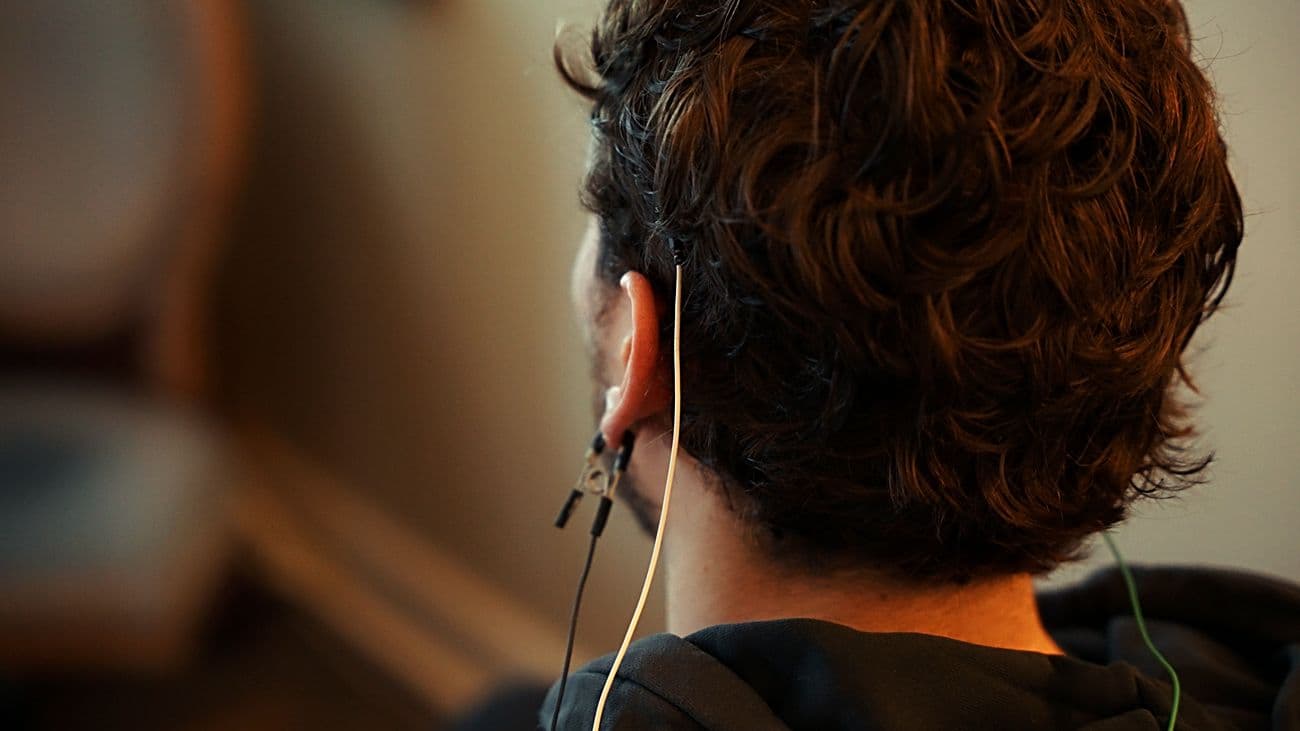
Sessions are quiet and passive — small sensors, a very low-energy feedback signal, nothing to perform and nothing to keep up with at home. LENS isn’t a treatment for anything, and it belongs after the paragraph above rather than instead of it.
A session runs about 30 minutes in a comfortable chair. What we check at every visit is what you would actually notice: sleep, tension, reactivity, and how the day after a hard day goes — and the plan follows that rather than a template. Clients commonly report feeling steadier over a series of visits, and how much changes varies from person to person.
The two pages this one sits closest to.
LENS is a wellness service. It works alongside — never in place of — your doctor, therapist, or school supports.
Describe it in whatever words you’ve got. We’ll be straight with you.
Including the physical part nobody asks about. We’ll listen, answer honestly, and say plainly if LENS isn’t the right fit — before you book anything.
If we don’t think LENS is right for you, we’ll tell you on the phone — before you ever book or pay for anything.
The call is free · No referral needed · HSA & FSA accepted