The 3 a.m. waking, and why it isn’t random
You didn’t wake for a reason. No noise, no bad dream you can recall, nothing to do. You were simply awake, at more or less the hour you were awake yesterday — and then you were awake for another ninety minutes.
It is rarely the noise, or the temperature, or the bathroom
The first thing most people do is look for the cause in the room. Sometimes it is there. More often the trigger turns out to be incidental — something small that a lighter night let through and a heavier one would not have noticed at all.
What people describe to us is waking frequently, or at 3 a.m. for no reason, on nights that are otherwise unremarkable. The consistency is the interesting part. A system waking at roughly the same point most nights is doing something regular, and regular things tend to have a mechanism rather than a cause you can name from inside them at the time.
Getting back down is the harder half
The waking is usually not what costs the night. The ninety minutes afterwards are. Going up and coming back down are two different jobs, and at three in the morning the second one is being attempted with whatever is left after a full day — which is not much.
Waking is a moment. The hour and a half afterwards is the part that costs you tomorrow.
It is also why the advice that works at bedtime does so little here. Regulation is a capacity that depletes and recovers, and what you had at eleven o’clock is not what you have at three. Holding yourself to the version of you that fell asleep easily sets a standard the system cannot meet at that hour.
If the thoughts are the main event
For some people the waking is incidental and the mind is the whole story — awake, and immediately going through everything. That is a different subject with a different page behind it. If the same circling is there in the afternoon, with nothing in particular setting it off, the nights are one symptom rather than the problem, and the anxiety page is the better place to start. The link is at the foot of this one.
What tends to help
Make the plan before you need it. What you do at three in the morning is best decided at nine in the evening, because deciding anything at three is precisely the thing that isn’t available.
Lower the stakes on the waking itself. A night interrupted once is an ordinary night. The arithmetic people do about how much sleep is left is usually what turns it into a bad one.
And treat the load as the intervention. Food, unbroken recovery time, and what the day asked of you shape the night more than anything that happens in the last ten minutes before bed.
Have it looked at
Waking repeatedly at night is one of the things a doctor should hear about directly. Sleep apnea is the common one and it is identified by testing rather than by inference; thyroid problems, low iron, medication effects, and mood and anxiety disorders all produce broken nights too. They are common, and none of them is something to reason your way past. We can’t test for any of it, and neither can an article — if nobody has looked, that is the first move rather than the last.
Where LENS fits
Sessions are quiet and passive — small sensors, a very low-energy feedback signal, nothing to perform and nothing to keep up with at home. LENS isn’t a treatment for sleep disorders, and it belongs after the paragraph above rather than instead of it.
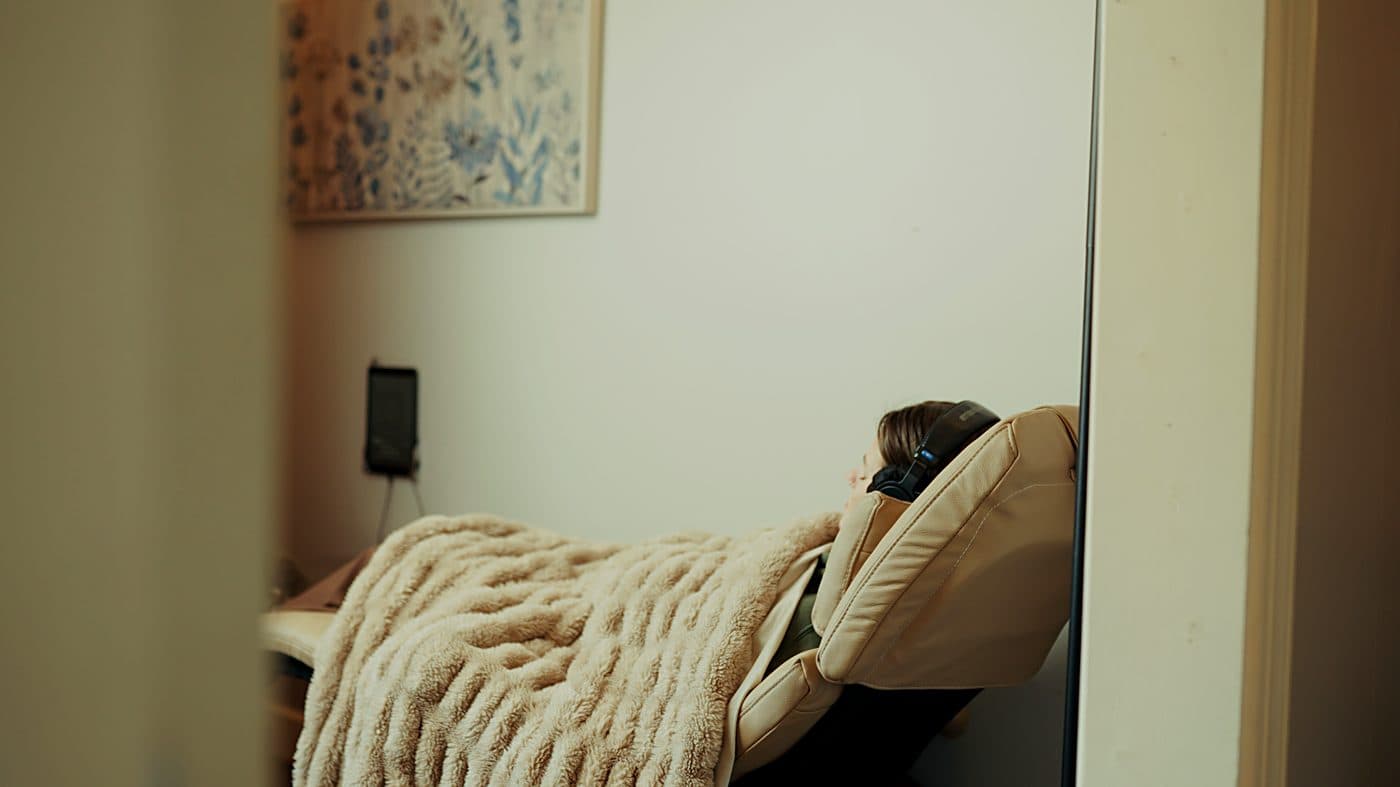
A session runs about 30 minutes in a comfortable chair. Sleep is one of the first things we ask about at every visit, and what we track is specific: falling asleep, staying asleep, and how the mornings actually feel. The plan follows that rather than a template, and how much changes varies from person to person.
The two pages this one sits closest to.
LENS is a wellness service. It works alongside — never in place of — your doctor, therapist, or school supports.
Tell us what your nights actually look like.
We’ll listen, answer honestly, and say plainly if LENS isn’t the right fit — on the phone, before you book anything.
If we don’t think LENS is right for you, we’ll tell you on the phone — before you ever book or pay for anything.
The call is free · No referral needed · HSA & FSA accepted